 how-to
Choosing Fine Art for Gallery: A 2026 Guide
Table of Contents
- Define Your Aesthetic Before Choosing Fine Art for Your Gallery
- Art Curation Best Practices: Scale, Proportion, and Visual Weight
- Gallery Wall Layout Ideas That Create Cohesion
- Large Format Art Display Tips for High-End Spaces
- Provenance, Authenticity, and Fine Art Investment Value
- Art Preservation: Environmental Factors Collectors Overlook
- Digital Art and AI-Assisted Pieces in a Fine Art Gallery Collection
- Budgeting and Sourcing: Prints, Originals, and Bespoke Commissions
Last Updated: August 26, 2026
Define Your Aesthetic Before Choosing Fine Art for Your Gallery
Choosing fine art for a gallery wall is one of the most consequential design decisions you can make. Most people start with the art itself, a mistake. Start with the space: the architecture, light, and existing palette define what will feel inevitable on your walls versus what will always look like an afterthought.
At ThurmanatorX, we work with collectors who've made this mistake: they fall for a piece, buy it, and then spend months wondering why it never quite fits. The solution is almost always that they skipped the foundational step of defining their aesthetic before browsing a single collection.
Identify Your Architectural DNA and Color Palette
Architectural DNA is the visual language embedded in your space: ceiling height, trim style, floor material, and natural light sources. A high-ceilinged loft with industrial steel windows calls for a different art language than a traditional home with crown molding and warm oak floors.
Before choosing fine art, audit your space: What is your dominant color palette? Pull three to five colors from your existing furnishings and finishes. Is the overall mood warm or cool? What is the scale of your existing objects? Large, spare spaces demand large-format work. Intimate rooms need restraint.
Color cohesion does not mean matching. It means building a palette where the art's tones sit within the same temperature range as the room. An Afrofuturist canvas with deep golds and indigo reads powerfully against a warm neutral wall; the same piece against cool gray can feel jarring.
The Psychological Impact of Art on a Space
Art does not merely decorate, it sets the emotional register of a room. According to research on art and wellbeing in built environments, exposure to visual art in living spaces measurably affects mood, stress response, and perceived spatial quality.
Dark, high-contrast compositions create intimacy and tension, working well in dining rooms and studies. Expansive, luminous works open a space psychologically, making rooms feel larger and more contemplative.
Art Curation Best Practices: Scale, Proportion, and Visual Weight
The most underrated skill in art curation is understanding visual weight. A small, intensely detailed piece can anchor a wall as effectively as a large canvas, depending on its contrast, complexity, and framing.
Art should fill roughly 57 to 75 percent of the available wall width above a piece of furniture. Large-format work that bleeds closer to the edges creates drama. Smaller work centered on a vast expanse creates isolation, which can be intentional.
Measuring Wall Space and Establishing Eye Level
Before hanging anything, measure the wall precisely. Note the width, height, and position of any architectural interruptions, outlets, switches, windows, and doorways.
Eye level in residential spaces is conventionally set at 57 to 60 inches from the floor to the center of the artwork. In rooms with higher ceilings or where viewers are primarily seated, adjust accordingly. Use painter's tape to mock up the footprint of a piece on the wall before committing to holes.
Mixing Mediums, Texture, and Negative Space
The most compelling gallery walls mix mediums: a large-format canvas alongside a sculptural element, a framed print next to a textured fiber piece. Texture creates visual interest that a flat wall of prints cannot achieve.
Negative space is not wasted wall, it is the breathing room that allows each piece to be seen. Overcrowding a gallery wall is the single most common error in DIY curation.
| Curation Element | Common Mistake | Better Approach |
|---|---|---|
| Scale | Hanging art too small for the wall | Fill 57-75% of wall width above furniture |
| Eye level | Hanging too high | Center at 57-60 inches from floor |
| Negative space | Overcrowding the arrangement | Leave deliberate gaps between pieces |
| Texture | All flat prints, no variation | Mix canvas, metal, and organic materials |
| Color cohesion | Matching colors exactly | Match temperature range, not specific hues |
Gallery Wall Layout Ideas That Create Cohesion
A gallery wall fails when it looks assembled rather than curated. The difference is intentionality: every piece should relate to every other piece through at least one shared element, color temperature, subject matter, frame style, or medium.
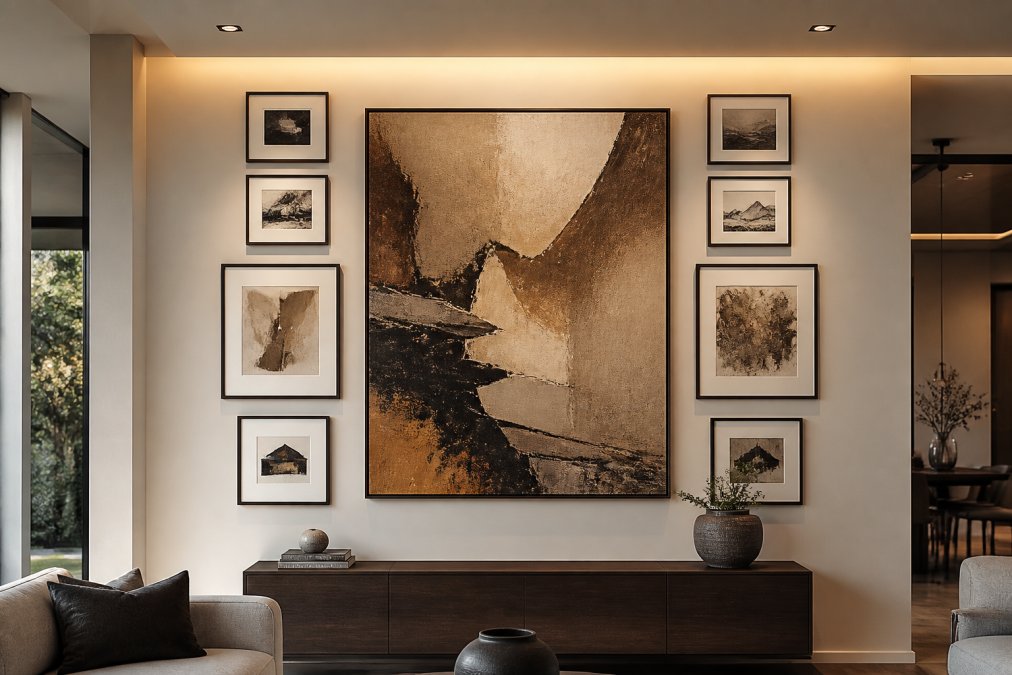
Gallery wall layout ideas cluster around two schools: the grid and the salon hang. The grid is precise and formal, working well in contemporary spaces. The salon hang is eclectic and more forgiving of mixed sizes and frames.
The Focal Point Formula
Every successful gallery arrangement has a focal point: one piece that commands attention and around which everything else is organized. This is usually the largest work, the highest-contrast piece, or the most conceptually significant item.
The focal point formula works as follows: Identify or select the anchor piece first. Hang it at eye level, centered on the wall or above the primary furniture piece. Build outward from the anchor, maintaining consistent spacing (typically 2 to 3 inches between frames). Use pieces of decreasing visual weight as you move away from the center. Step back and assess the composition at viewing distance before finalizing.
Eclectic vs. Minimalist Arrangements
Eclectic arrangements celebrate variety. Mixed frame finishes, varied sizes, and different mediums coexist, unified by color palette or thematic cohesion. This suits collectors who have acquired pieces over time.
Minimalist arrangements demand discipline. Two or three pieces, significant negative space, and absolute consistency in framing and matting. The power comes from restraint.
Large Format Art Display Tips for High-End Spaces
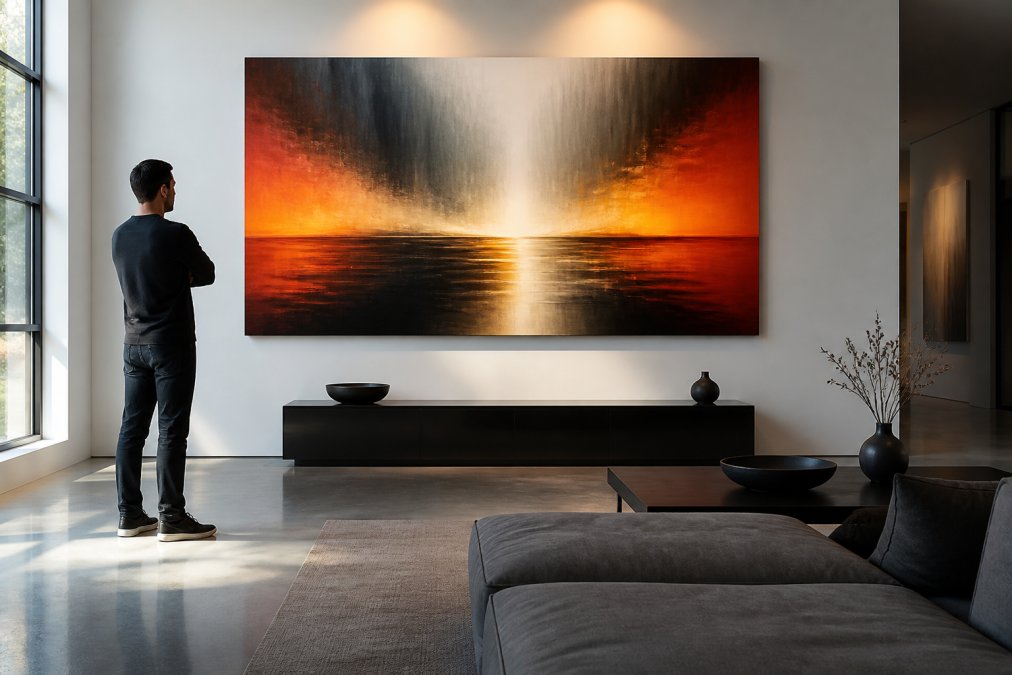
Large-format art transforms a space in a way that no other design element can replicate. A canvas four feet wide or larger becomes an architectural feature, not just decoration. Display decisions, lighting, framing, hanging hardware, either honor that scale or undermine it.
Lighting Temperature and Placement
Lighting is the variable that most collectors underinvest in. The wrong light source can shift the color temperature of a canvas dramatically. Warm tungsten light pulls yellows and reds; cool daylight-spectrum LEDs read blues and greens more accurately.
For large-format art display, the Illuminating Engineering Society's guidelines on museum and gallery lighting recommend a color rendering index of 90 or above to ensure colors appear as the artist intended. Gallery-grade LED picture lights and adjustable track lighting both achieve this. Avoid fluorescent sources entirely.
Position the light source at a 30-degree angle to the artwork's surface to minimize glare while creating the dimensional shadow that makes texture visible.
Framing, Matting, and Hanging Hardware
Framing decisions are permanent in practice. Choose frames that complement the art without competing with it. For large-format canvas prints, a gallery wrap (where the canvas wraps around a deep stretcher bar) often requires no frame at all.
When matting is used, archival-quality, acid-free mat board is non-negotiable for any piece intended to hold value. Hanging hardware for large-format pieces should be rated for at least twice the weight of the framed work. French cleats are the professional standard, distributing weight across a broader wall area.
Provenance, Authenticity, and Fine Art Investment Value
Provenance is the documented history of an artwork's ownership and origin. For investment-grade collecting, provenance is the foundation of value. According to the Art Loss Register's guidance on provenance documentation, documented ownership history is one of the primary factors that determines an artwork's authenticity and market viability.
How Blockchain Verification Strengthens Provenance
Blockchain verification creates an immutable, timestamped entry that cannot be retroactively altered. For collectors choosing fine art for a gallery, this provides a verifiable chain of custody from creation through every subsequent transfer.
ThurmanatorX integrates blockchain verification into every piece it produces, creating a permanent authenticity record tied to each limited-edition canvas. Public blockchain records are distributed across thousands of nodes; they do not disappear when a single company changes its business model.
Limited Editions, Print Quality, and Resale Value
Limited editions derive their value from scarcity, but scarcity alone is insufficient. The edition size must be credibly enforced, and the print quality must be archival-grade to support long-term value. ThurmanatorX limits each size to 30 prints, small enough to create genuine rarity, with blockchain verification ensuring that edition cap is provable.
For resale value, print quality is the physical foundation. Archival pigment inks on museum-grade canvas substrates resist fading for decades under normal display conditions.
Art Preservation: Environmental Factors Collectors Overlook
Art preservation separates serious collectors from casual buyers. Most people hang a piece and forget it. Collectors who intend to hold value manage the environment around their art carefully.
The primary environmental threats to canvas works are: UV exposure causes irreversible fading; UV-filtering window film or UV-blocking glazing mitigates this significantly. Humidity fluctuation stresses the substrate over time; the American Institute for Conservation's guidelines on environmental standards recommend maintaining relative humidity between 45 and 55 percent. Temperature extremes should be avoided; consistent temperature, ideally between 65 and 70 degrees Fahrenheit, extends the life of both substrate and pigments. Airborne pollutants from kitchens and fireplaces accumulate invisibly on canvas surfaces.
These factors are rarely discussed in buying guides. They are, however, the difference between a collection that appreciates and one that quietly deteriorates.
Digital Art and AI-Assisted Pieces in a Fine Art Gallery Collection
The question collectors most often ask is whether AI-assisted art belongs alongside traditionally created works. The honest answer: the medium is not the measure of legitimacy. Artistic vision, execution quality, and rarity are.
AI-assisted art is not a shortcut. At its highest level, it is a new medium requiring deep creative direction, curatorial judgment, and technical skill. The difference between a compelling AI-assisted canvas and generic output is the same difference that separates a masterful photograph from a snapshot: intention, craft, and a singular point of view.
ThurmanatorX's collections, Aphroeclectix, Aphrodisidark, and Aphrochrysalis, are built on this premise. Each piece reflects a specific creative vision at the intersection of Afrofuturist narrative and contemporary digital aesthetics, produced as large-format canvas prints with archival production values.
For collectors integrating digital and AI-assisted work into an established collection, treat the piece on its own terms. Assess the edition size, production quality, provenance documentation, and creative integrity. A blockchain-verified, archivally produced piece in a strictly limited edition of 30 is a more defensible investment than an unlimited open-edition print regardless of medium.
Budgeting and Sourcing: Prints, Originals, and Bespoke Commissions
Budgeting for art is where collectors most frequently make category errors. The relevant question is not "how much does this cost?" but "what am I actually buying?"
A limited-edition, archivally produced, blockchain-verified canvas print from a recognized collection is categorically different from an open-edition print. The value proposition lies in documentation, scarcity, and production standards.
Sourcing options broadly fall into three categories: Open-edition prints are widely available with no scarcity and limited investment thesis. Limited-edition fine art prints have defined edition size, archival production, and documented authenticity. ThurmanatorX operates in this category, with editions capped at 30 per size. Original works and bespoke commissions offer maximum scarcity and highest price points.
For most collectors choosing fine art for a gallery, limited-edition prints represent the optimal balance of accessibility and investment integrity. Verify that "limited edition" is enforced, not just claimed, and that production quality meets archival standards.
Visit ThurmanatorX to review current collection availability, edition status, and pricing for large-format canvas works.
Curating a fine art gallery in a private space is a long-term commitment. Decisions made early about scale, lighting, provenance, and preservation compound over time. ThurmanatorX offers large-format, blockchain-verified, limited-edition canvas prints with archival production standards, nationwide shipping, and collections built around a coherent Afrofuturist creative vision. Explore the Aphroeclectix, Aphrodisidark, and Aphrochrysalis collections to find works that belong on walls designed to hold value.
Frequently Asked Questions
How do you balance color and scale when choosing fine art for a gallery?
Start with your room's dominant color palette and choose art that shares at least one anchor tone, this creates cohesion without making the space feel matched. For scale, the general rule is that a single piece should occupy 57-75% of the wall width it anchors. Larger rooms support bolder, large-format work. Smaller walls benefit from grouped arrangements where the collective composition, not any single piece, carries the visual weight.
What factors determine the investment value of fine art prints?
Edition size is the most immediate factor, smaller editions preserve scarcity and support long-term value. Beyond that, provenance documentation, print quality (archival inks, substrate), and the artist's market trajectory all matter. Blockchain verification adds a verifiable, tamper-resistant ownership record that traditional certificates of authenticity cannot match. Condition is equally critical; UV-protective glazing and stable environmental storage protect both the physical piece and its resale potential.
How does blockchain verification impact the value of fine art?
Blockchain creates an immutable record of a work's origin, edition number, and ownership history, information that previously required paper certificates vulnerable to loss or forgery. For collectors, this means provenance can be confirmed instantly by any future buyer, which reduces friction at resale. The record lives on a decentralized ledger, so it persists independently of any single company or platform. For limited-edition prints, that transparency directly supports collector confidence and long-term value.
What type of art is in high demand right now?
Large-format, limited-edition works that blend cultural narrative with technical innovation are drawing strong collector interest. Afrofuturist art, AI-assisted compositions, and pieces with documented blockchain provenance occupy a growing segment of the market. Collectors increasingly want work that functions as both a visual statement and a verifiable asset. Pieces that ship in archival condition with full authentication records are especially sought after by buyers treating art as a tangible, long-term holding.
This article was written using GrandRanker
Frequently Asked Questions
How do you balance color and scale when choosing fine art for a gallery?
Start with your room's dominant color palette and choose art that shares at least one anchor tone — this creates cohesion without making the space feel matched. For scale, the general rule is that a single piece should occupy 57–75% of the wall width it anchors. Larger rooms support bolder, large-format work. Smaller walls benefit from grouped arrangements where the collective composition, not any single piece, carries the visual weight.
What factors determine the investment value of fine art prints?
Edition size is the most immediate factor — smaller editions preserve scarcity and support long-term value. Beyond that, provenance documentation, print quality (archival inks, substrate), and the artist's market trajectory all matter. Blockchain verification adds a verifiable, tamper-resistant ownership record that traditional certificates of authenticity cannot match. Condition is equally critical; UV-protective glazing and stable environmental storage protect both the physical piece and its resale potential.
How does blockchain verification impact the value of fine art?
Blockchain creates an immutable record of a work's origin, edition number, and ownership history — information that previously required paper certificates vulnerable to loss or forgery. For collectors, this means provenance can be confirmed instantly by any future buyer, which reduces friction at resale. The record lives on a decentralized ledger, so it persists independently of any single company or platform. For limited-edition prints, that transparency directly supports collector confidence and long-term value.
What type of art is in high demand right now?
Large-format, limited-edition works that blend cultural narrative with technical innovation are drawing strong collector interest. Afrofuturist art, AI-assisted compositions, and pieces with documented blockchain provenance occupy a growing segment of the market. Collectors increasingly want work that functions as both a visual statement and a verifiable asset. Pieces that ship in archival condition with full authentication records are especially sought after by buyers treating art as a tangible, long-term holding.